
Education Through Settlements
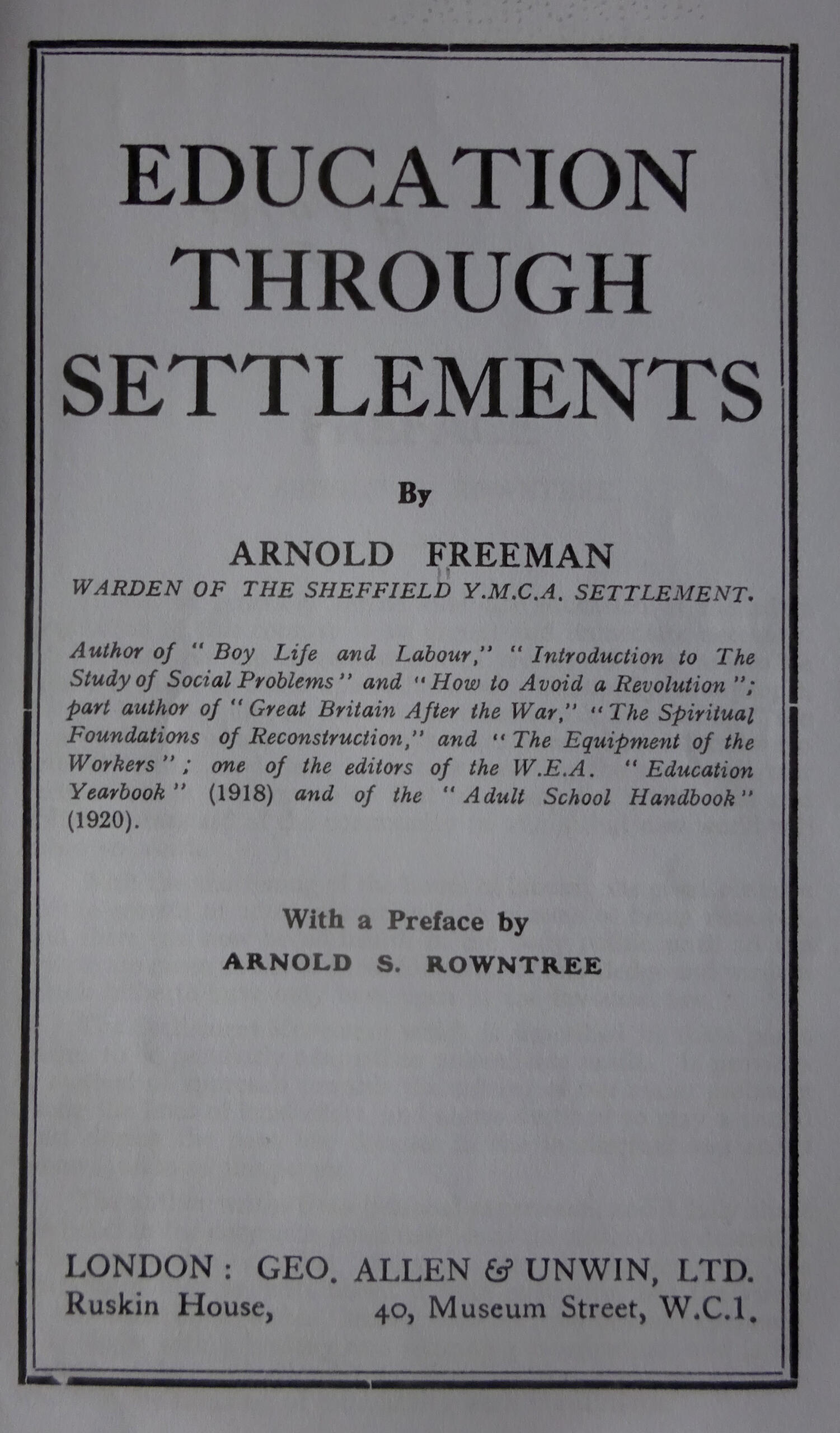
Education Through Settlements
Arnold Freeman
Over one hundred years ago Arnold Freeman established a movement in Upperthorpe that sought to provide education for workers and the community in an innovative way.
It provided the foundations for being good citizens, parents and community leaders.
Freeman listened to the voices of the people living in the locality, shared their lives and produced learning materials, including performance in their very own theatre, the Little Theatre.
‘Education Through Settlements’ reflects Freeman’s thoughts based on his life experience and commitment to education. He writes about the Settlement Movement of which there were many in the first half of the 20th century. Perhaps the most famous of them all was Toynbee Hall in London. It is a guidebook for community education.
Education Through Settlements
Arnold Freeman
The Library
“One of the main purposes of the Settlement is to stimulate interest in the locality where it is placed, – in it’s geography, it’s history, it’s economic position, it’s social conditions, it’s educational system, it’s possibilities. I like to think of the library as filled, not so much with the greatest of the world’s literature and the best modern text books as with every procurable book produced by or descriptive of the locality itself. And from this it follows that I visualise the library I its relation to the research which every effective Settlement will be presently undertaking”.
“……. If those who attach themselves to the Settlement are to make their own town a Utopia, they must subject themselves to the fundamental instruction which nothing but first hand investigation will give……….”
The Hall
The obvious use for the hall is for lectures. But it is the least educational of its uses. A lecture to a heterogenous audience always tends to b superficial; with a large gathering even the questions at the close do not develop into an informative discussion; and unless the lecturer has a rare genius, so he can get the audience to participate in the lecture….. his hearers tend to be too passive throughout. The lecture and course of lectures are too valuable as instruments of education not to be extensively used, but it is the business of the Settlement to find out new ways of educating, and only to be satisfied with the old where they are the best discoverable.
“……..a debate will be far more thought provoking”
“Considerably greater in value than either the lecture or the discussion is the play. The mere reading of a first rate play has such powerful effects, both on those who read and those who listen, that it is astonishing to find it so little done. People will listed spell-bound to the to the book of Job read as a dramatic dialogue; and so they would, I am convinced, to its modern counterpart, The Undying Fire by H. G. Wells; and to a thousand other productions, whether called plays or not, by writers of every age and country and every point of view”.
“ But the supremely educational thing – it might be perhaps regarded as the consummation of the activities of the Settlement – is the production of a play of which every feature – manuscript, scenery, and acting are home made. It is not merely that a hundred varying demands are made upon those who undertake such productions; it is the opportunity that is offered for the self expression of the locality and the age, which is one of the most sacred duties of the Settlement to foster”.
“So important is dramatic work that wardens might seriously ask themselves whether their hall should not be permanently fitted up as a theatre, and whether that theatre should not become the “little” or repertory theatre of the village or town”.
“The very atmosphere of a Settlement should be music……….”
Author: Arnold Freeman